Showing posts with label iolani palace. Show all posts

Monday, April 21, 2014

Iolani Palace revisited


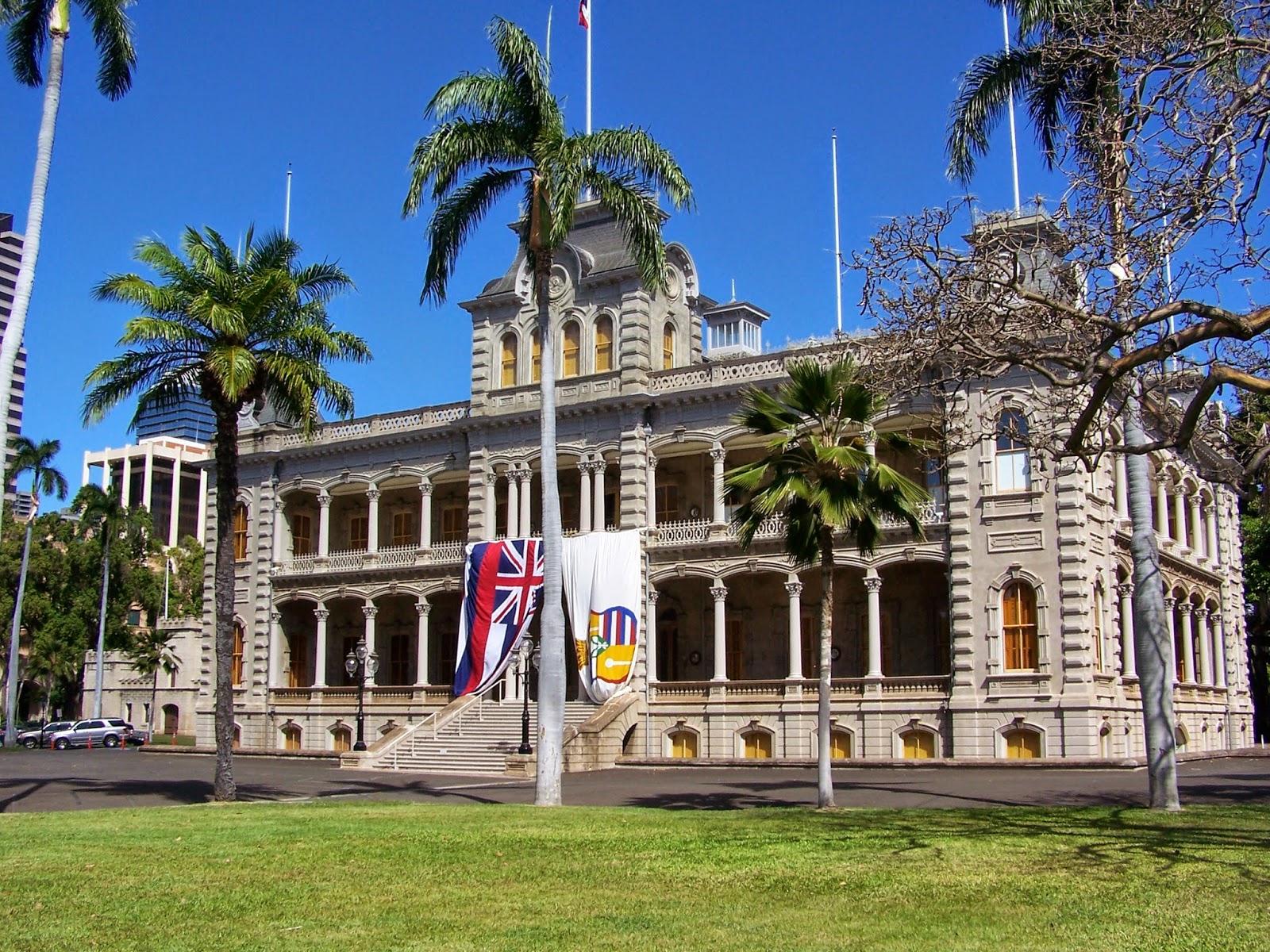
I've had people ask me about what to do when they are in Hawaii. I last wrote about Iolani Palace in January of 2011. For me there was no question in my mind that this building in downtown Honolulu should be the first item that I would recommend to people. 

Iolani Palace with flags
Iolani Palace was constructed starting on December 31, 1879 when the cornerstone was laid and had residents, King Kalakaua and Queen Kapiolani move into the palace in December 1882.  For a few short years, the palace was the heart of the Hawaiian monarchy until on January 17, 1893, Kalakaua's successor, Queen Liliuokalani, while at the end of a bayonet was pointed at her, was forced to sign over the powers of her constitutional monarchy rather than risk the lives of her people.

While being built, King Kalakaua had many technical marvels of the day incorporated into the structure.  Indoor plumbing, gas lights which were later replaced with electric bulbs and the recently invented telephone were amenities available to the King, Queen and their guests.  Many parties and celebrations were held on the palace grounds often lasting until the wee hours of the morning.

After the overthrow, the contents of the palace were thrown out, given away or sold.  The palace served many functions with the main function of acting as the government capital building until 1969 when the government moved into the new state capital building built just mauka  (towards the mountain) of the palace.  The Friends of Iolani Palace took over as care takers of the palace and palace grounds and have worked hard and diligently to restore the palace to its former glory.

Tours are available daily and throughout the year special events take place at the palace or own palace grounds.  As part of the guided tours the docents will lead you through the rooms of the first and second floor of the palace and then after you remove the protective booties you had put on before the tour began, you will be led to the basement galleries.  As of this writing, some of the crown jewels for the Kingdom of Hawaii are on display in the first floor throne room.  In the basement galleries are other royal jewelry pieces including the pin that Queen Liliuokalani wore to Queen Victoria’s Golden Jubilee made of diamonds studding a butterfly design whose wings would actually move and flap gently.  Royal Orders from King Kalakaua’s trip around the globe, the first royal monarch to ever do so, are displayed for visitors to examine.  The orders giving recognition that the Kingdom of Hawaii was truly something, signifying that the political leaders around the world were friends and friendly with the King and Queen of Hawaii.
Iolani Palace Dining Room 
For tour and special event information check out www.iolanipalace.org for specifics of hours and costs.  If you have a chance to visit the palace at the end of December in the evening, it is highly recommended by myself  The tour is set up to commemorate the birthday of Queen Kapiolani who was born on December 31, 1834. It’s very rare to be able to visit the palace at night with the interior lighting being used as well as people dressed in period costumes. With the environment set, you can really picture yourself and feel like you’ve been invited to a soiree given by Hawaiian Royalty.


Tuesday, January 11, 2011

Kamaaina Iolani Palace Tour

Hawaii has one of the most unique structures anywhere in the United States.  It resides at 364 South King Street in Downtown Honolulu.  It is Iolani Palace, the residence of the last ruling Kings and Queens of the Kingdom of Hawaii.  Thanks to The Friends of Iolani Palace, today you and me, a common person, can walk where royalty used to live. As a service to the community, usually the first Sunday of the month is considered Kamaaina Sunday when local residents and active military are offered tours of the residence at no charge.

I've taken advantage of Kamaaina Sunday on numerous occasions over the years that I have lived here.  People say to me, "You going on that thing again?"  I respond "Yeah!"  Each time I have taken the tour, it's a new experience.  I never come away from the tour empty handed.  I learn something, I notice something that I hadn't noticed before, I get to appreciate what gets passed by every day by thousands of people driving down King Street.

The first tours of the day start at 9am and I head down to arrive on the grounds about 8:30ish.  This usually gets me on one of, if not the first tour of the day.  I show my drivers license and am given a ticket that has a detailed and intricate design on it.  This is done at the Iolani Barracks which are to the left of the palace as you look at it from King Street.  As part of the barracks structure there is a room with a short film explaining some of the history of the palace, a restroom and locker location and the main gift shop.

The tour starts at the mauka or mountain side of the palace where we are greeted by the docents.  We are given special booties to place over our footwear which is necessary to help protect the floors which on the tour we find out is made of soft woods.  Most of the docents are women who are adorned in long flowing muu muus, the gentlemen in aloha shirts.  We are given the ground rules which include no cell phones, no gum, no candy, no liquids and no video or still photography.

To set the mood for the tour we're asked to step back in time to the late 1800's, 1882 to be exact, when the palace first opened and we've been invited to the palace for a royal dinner.  We're brought into the Grand Hall and shown the portraits of the Kings of Hawaii from Kamehameha the Great to Kamehameha V who reigned through blood lineage and then to Lunalilo who was elected.

We are then welcomed into the Blue Room which is where guests were received upon arriving at the palace.  Inside this room is the portrait of King Kalakaua who is responsible for ordering the construction of the building.  As the name implies, the room is done in a deep blue color contained in the curtains, furniture and the rug.  There are chairs and a couch for us to observe as well as a piano in the corner.

From the Blue Room we cross a threshold and are now in the State Dining Room.  Laid out in front of us is a table set up for a formal dinner.  This room takes up two thirds of the ewa wing of the palace.  The docent tells us of how they may have had forty five different items to choose from over the multiple courses of the meal.  The King's chair wasn't at the end of the table, but in the middle as he loved to talk with his visitors to invite conversation and hear news both locally and internationally.  Today the room is set up to seat eight guests joining with the King.

From there we are put on an elevator installed during the refurbishment of the palace in the 1960's to go up to the second floor where under normal circumstances, a guest of the King or Queen would not go.  There are dumb waiters to bring items from the kitchen on the ground floor to the State Dining Room and up to the private residences on the second floor.  We tour the rooms above where we were on the first floor.  This would include the King's bedroom, his office and the music room.

On the other side of the building we are bought into a room that has special significance with its darkened windows.  It was the room where Queen Liliuokalani was imprisoned after the overthrow of the Hawaiian monarchy.  On display is the quilt that the Queen made during that time.  The docents give a brief overview of what happened.  I've been on tours where some of the people in the group want to go into more detail but the docents that I've had have managed to keep it to the high level overview and not get caught up in the passion that surrounds those events.

After being shown the other two large rooms we once again head back down the elevator to be brought into the final room of the formal tour, the Throne Room.  In here the docents give a descriptive story of what it would have been like to attend a party at the palace.  Outside on the lanai the Royal Hawaiian Band would be playing songs that would be on our dance card of which our ticket is a partial replica of what that dance card would have looked like.  The docent describes what the ladies and gentlemen attending would have been wearing.  A special note to the ladies: the King made an effort to dance with all the ladies in attendance.  As the tale of the evening is brought to a close, so is the tour as we are lead back the the doors we entered.  We take off the booties, but the tour isn't quite over.  We, as a group, are lead to the ground floor of the building and the galleries there.

For me, these galleries are amazing.  In this area are the main functional areas that were used for the day to day running of the palace.  If didn't get to the main gift shop, there is a small, and I do mean small gift shop located here.  Today, the crown jewels for the Kingdom of Hawaii are on display in a secured area.  To see the crown and royal orders that were both given and received put a new light on the monarchy for me.  Kalakaua was very progressive from his circumnavigating the globe to the installation and use of a telephone system to having hot and cold running water and having electricity installed in the palace.  Many firsts can be attributed to him personally.

After exploring the galleries, you can explore the grounds around the palace.  Take in the detail of the architecture from the outside or even imagine what it would have been like in the late 19th century when the ocean came up to approximately a block away where Queen Street currently is located.  On one side is located the sacred mound where past Hawaiian chiefs may be buried and on the other is the Coronation Pavilion.  Around a number of the trees near the pavilion are benches where if you brought or bought something to snack on you can sit here and enjoy the view and the sounds.

Iolani Palace is a place that should be visited by both tourist and residents alike.  For residents, there is no reason not to go especially since you can visit for free.  Click here to see the Kamaaina Sunday schedule. To find out more information about Iolani Palace, visit the Iolani Palace web site.  Don't be afraid to have repeat visits.  Changes do occur.  This last trip the crown was in the Throne Room instead of the gallery, a display of the past and present restoration was installed and we were told that in the next year, the Music Room up on the second floor will take on a new look as many items have been found, are being restored and will be put out on display.  I know I'll be making a trip back to see the additions.
Sunday, May 16, 2010

Movie Review: Princess Ka'iulani

The correct name of the Princess contains the 'okina or the glottal stop which is treated like a character within the Hawaiian language. For the Princess' name, it is between the a and the i. I don't have the correct font to do the Hawaiian language so for the rest of the review I won't be using any of the formal Hawaiian spellings for this formal Hawaiian picture. Why am I making this disclaimer? Because when the movie was shown at the Hawaii International Film Festival last year it was titled The Barbarian Princess and there was a big uproar within the Hawaiian community and I don't want that same uproar over my review for not having formal spellings of the Hawaiian names or places.


The movie Princess Kaiulani is not a documentary, but it attempts to convey some of the history of Hawaii's change from a Kingdom with its own sovereign rulers to that of an annexed property of the United States of America while focusing on the young ruler. Most Americans don't know about Hawaii's history like how the missionary families gained power in the islands or what led up to Hawaii being the last state admitted to the Union. Just last year we celebrated our 50th anniversary of the admission. I use the term "we" loosely as there were some people who protested what happened. Ultimately, President Clinton signed an apology resolution in 1993 for the part that the US government played in the illegal overthrow of the Hawaiian Monarchy in 1893.

In the movie, Princess Kaiulani (Q'orianka Kilcher) traveled from England to Washington DC after the overthrow of the Monarchy to talk to President Grover Cleveland. The problem was she had to do it as a citizen and not a princess. She made an explanation to the President involving salt, pepper and cumin. It was a brilliant way to explain the situation to an outsider.

What I found great about the movie is that they used the actual Iolani Palace here in Honolulu for the movie. I've been into the palace a number of times on Kaamaina Sunday where residents are allowed to take the tour for free. The floors are made of Douglas fir so you're required to wear these booties, kinda like surgical booties over your personal footwear to protect the floors.

They have some of the furniture that was in the Palace at the time of the overthrow and they have attempted to give you a feeling of what it would be like in the palace. The last part of the tour is the Throne Room where they describe how the windows would be open allowing people to walk in and out to the lanai or patio and the overall atmosphere during a royal gathering. To even see actors in period costumes on the screen brought a whole new meaning to me of the palace. There were a number of other exciting shots were shown in the movie including the room where Queen Likiuokalani was imprisoned where you can go during a palace tour, but also the Chamberlain's Office in the basement that you can't enter but just view through a Plexiglas door or Kaiulani walking up the grand staircase from the first to the second floor which you are NOT allowed to do at all.

The costumes for the movie were magnificent. I was reading where Kilcher had 20 some odd pieces that were made for the movie. Apparently many of the costumes were made not only to look like the designs of the time but also the material itself was that of the last decade of the 19th century. The one part that would make for a hard time would be the corsets. They were part of the time and were part of the requirements to be the foundation of the dresses. Several pieces of jewelry were reproduced to form the complete package to showcasing the style of the time. If you visit the basement gallery at the palace on display are the Crown Jewels of the Kingdom of Hawaii where you can see actual pieces worn by Hawaiian Royalty.

Something that non Hawaii audiences will be exposed to is some of the culture like the language and hula. Most people know hula as the smooth swaying of the hips called auwana but it didn't start out that way. Kahiko is the older style with strong forceful movements done to chants in Hawaiian olelo or language. Kahiko is generally not shown when there are tv specials coming from the islands. Audiences will experience the olelo both in chant and as conversational language. There is a beautiful scene while the princess walking on the beach, she's presented with a haku or woven lei with an accompanying chant. What was once a dying language has been making a come back. I'm glad this exposure is showcasing what a beautiful and lyrical language Hawaiian is.

The one part of the movie that didn't completely work for me were some of the transitions between segments of the movie. This wasn't the cinematic transitions with fades or wipes, but the abruptness of jumps between locations or situations. If there would be one recommended change, it would be smooth out some of those jumps.

Something that I do find of interest is about the choice of Kilcher as the Princess. A number of people complained about the original title. When it was suggested that Duane "The Rock" Johnson play Kamehameha the Great there were rumblings over a Samoan playing a Hawaiian. Disney is building a resort on Oahu and the Hawaiian community is saying they better get it right with their depiction of Hawaii. Yet strangely enough, I don't remember hearing anything about a non-Hawaiian playing the Hawaiian alii or royalty.

Audiences at the Hawaii International Film Festival sold out five showings of this movie as well as awarding it the Audience Award. It brings to people a great period piece shining a light on an undeserved portion of Hawaiian and American history while spotlighting Princess Kaiulani. If you can find this film at your local theater, I highly recommend checking it out. It is rated PG for some sensuality, brief language, smoking, thematic material and some violence and has a run time of one hour and 37 minutes.